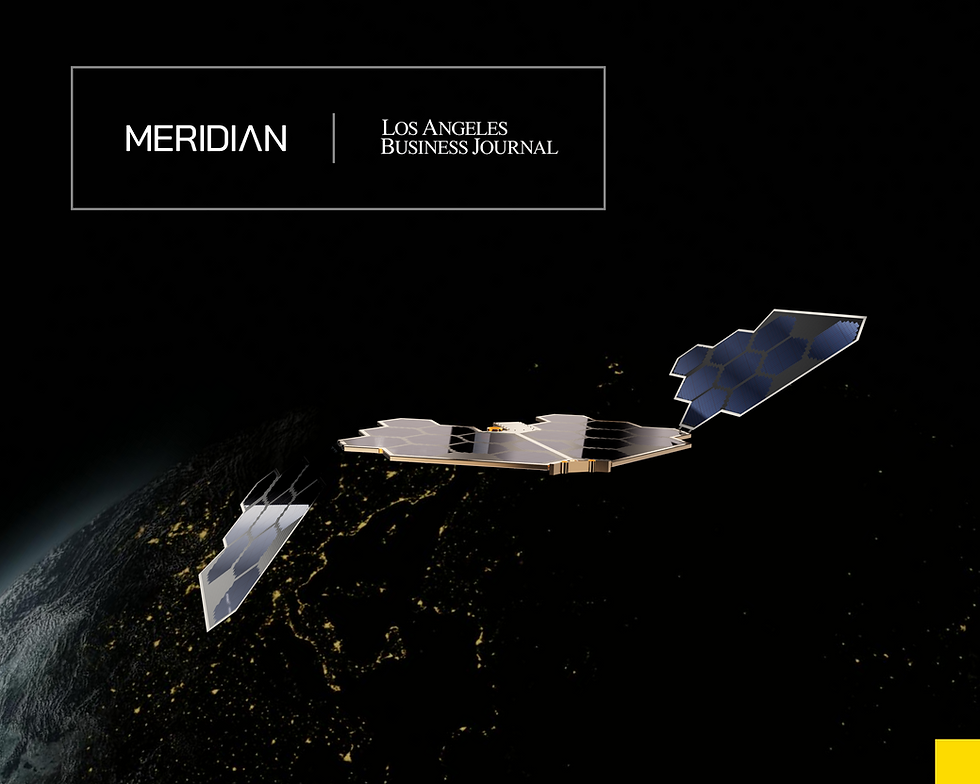
SpinLaunch raises $30 million for work on Meridian Space constellation
- Aug 18, 2025
- 2 min read

WASHINGTON — SpinLaunch announced $30 million in new funding for the company to support its development of a broadband constellation.
SpinLaunch said Aug. 18 that it closed $30 million in funding existing investors, led by ATW Partners. That amount includes a $12 million strategic investment from Kongsberg Defence and Aerospace announced in April.
The funds will support continued development of Meridian Space, a broadband constellation that SpinLaunch revealed in April at the same time as its agreement with Kongsberg. That agreement included a contract awarded by SpinLaunch to Kongsberg subsidiary Kongsberg NanoAvionics worth 122.5 million euros ($143 million) for 280 satellites.
Prior to the April announcement, SpinLaunch was best known as a startup developing an alternative launch system that used a centrifuge to accelerate vehicles to hypersonic speeds, effectively replacing the first stage of a conventional launch vehicle. The company, though, had been working behind the scenes on a constellation for several years.
The company is now focusing much more on Meridian Space. SpinLaunch announced in July it hired Massimiliano Ladovaz, former chief technology officer of OneWeb and chief operating officer of Eutelsat, as its new chief executive. David Wrenn, who had been chief executive of SpinLaunch, moved into a new position as chief innovation officer.
“I thought I was done with LEO,” Ladovaz said in a recent social media post. “I truly enjoyed building OneWeb, but let’s be honest: deploying a LEO constellation is incredibly hard. I had planned to move on and focus on something new.”
What lured him to SpinLaunch and its Meridian Space system, he wrote, was “a new kind of LEO technology and architecture” that offered far lower deployment costs than other constellations. “What if we could deploy a global LEO constellation at the cost of a GEO system? Impossible? Maybe not.”
A key element of that architecture is a proprietary multi-band reflectarray antenna that SpinLaunch claims is far more cost-effective than traditional satellite designs, although the company has released few details to support that claim. SpinLaunch said it recently completed testing of that antenna.
“Validating our reconfigurable reflectarray antenna through full-scale testing confirms we can deliver multi-band capability without the cost and complexity of traditional designs,” Wrenn said in a statement. “This is a critical step toward the development of the Meridian Space constellation and achieving both our technical and operational objectives.”
The new funding, the company told SpaceNews, will support effort to validate new technologies needed for the system and accelerate “go-to-market activities”.
The announcement of the new funding said nothing about SpinLaunch’s efforts to develop an orbital launch system. The company, which built a subscale centrifuge at Spaceport America in New Mexico for suborbital tests, said in April it signed an agreement to lease land on Adak Island in Alaska’s Aleutian island chain to host the larger centrifuge needed for the orbital launch system.
Wrenn, in an interview in April when he was chief executive, said efforts to build the orbital launch system were still in an “exploratory phase” at the time, and predicted it would take several years to develop.